What happens inside a cell when it grows old? A new study led by Prof. Petra Beli and Prof. Helle Ulrich at the Centre for Healthy Ageing (CHA) and Institute of Molecular Biology (IMB) in Mainz, Germany, provides one of the most detailed answers to date. In collaboration with Prof. Christian Behl from the University Medical Center and Dr Jia-Xuan Chen from IMB’s Proteomics Core Facility, they show that human cells experience a widespread and coordinated change in thousands of proteins as they enter senescence, a process closely linked to ageing. Proteins involved in chromatin organisation, gene expression, as well as protein production and disposal were particularly affected. Their findings, which were published in Nature Communications, provide new insights into the basic molecular mechanisms of ageing and could reveal new targets for therapies against age-related disease.
Our bodies continuously produce new cells to grow, repair damage and replace worn-out cells. However, most cells cannot divide forever. Cells that have divided repeatedly eventually stop proliferating, entering a state of arrest called senescence. As we get older, more senescent cells accumulate in our tissues. While this is important for preventing old, damaged cells from multiplying, senescent cells also produce inflammatory compounds that contribute to ageing. As a result, the gradual accumulation of senescent cells impairs organ function and leads to age-related diseases such as cancer, cardiovascular disease, arthritis and neurodegenerative disorders.
One way to combat this is to develop drugs that target and remove senescent cells. In animal models, this can slow age-related diseases, improving health and longevity. Understanding the molecular changes that occur in human cells during senescence is essential for finding better ways to detect and target them.
Following changes across the proteome in senescent cells
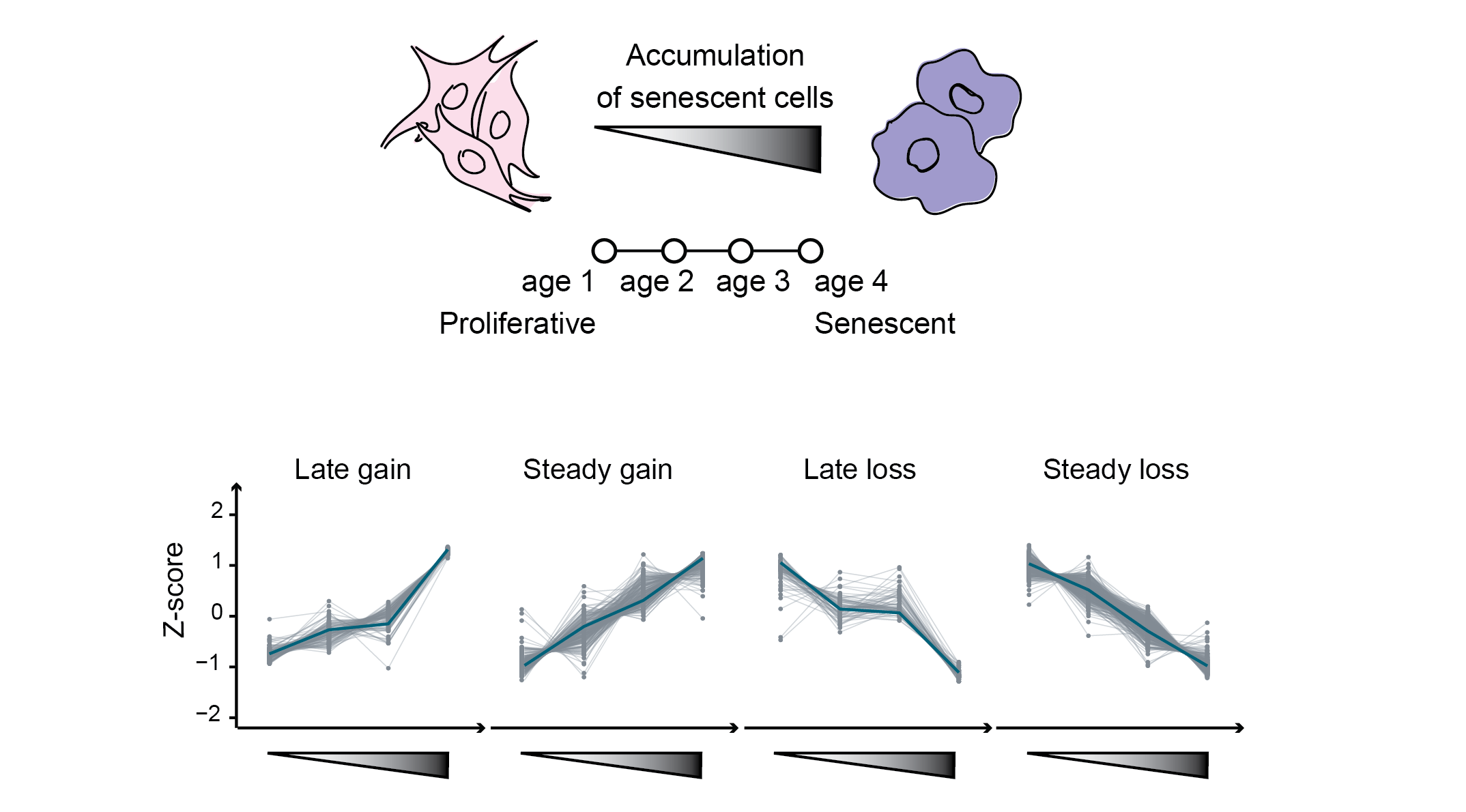
Using mass-spectrometry-based proteomics, the teams of Petra and Helle quantified nearly 6,000 proteins in human lung fibroblast cells at four successive stages, from actively dividing to fully senescent. The analysis revealed widespread, coordinated changes across many proteins during senescence.
“We applied a systematic and temporally-resolved multi-omics approach that revealed the coordinated rewiring of cellular networks, providing a valuable systems-level view of the molecular processes that shape and sustain the senescent state.”
- Nádia da Silva Fernandes, first author and PhD student jointly supervised by Petra Beli, Helle Ulrich and Christian Behl
A widespread reorganisation of chromatin and protein regulatory networks
One of the clearest patterns was the loss of proteins associated with chromatin. Proteins involved in gene transcription, RNA processing and chromosome organisation declined at different stages, suggesting an ordered restructuring of the nucleus and gene regulation. Another major change took place in proteins involved in proteostasis – the systems responsible for protein synthesis, maintenance and removing damaged proteins. Malfunctions in these systems are two of the primary hallmarks of ageing.
“We found that senescence involves a broad reorganisation of proteostasis, affecting not only how cells remove damaged proteins, but also how they produce new ones.”
- Prof. Petra Beli, Adjunct Director, IMB Mainz & Professor, JGU Mainz
Nádia da Silva Fernandes, the first author of the study, found that components of the cell machinery that make new proteins became depleted, while the cell’s two main protein disposal systems, autophagy and the proteasome, showed reduced activity. More than 500 proteins also became less soluble, a hallmark of protein aggregation that is common in senescent cells and contributes to neurodegenerative disease.
Senescence changes how cells tag proteins for disposal
The team also surveyed the abundance of two chemical protein tags, ubiquitin and SUMO, which cells use to modify protein stability, direct them to different locations, or mark them for disposal. They found an increase in two specific ubiquitin tags, namely K11- and K27-linked ubiquitin chains. This may reflect attempts by senescent cells to manage damaged proteins and reorganise their cellular quality-control systems.
A distinctive signature of senescence
The changes in senescent cells were distinct from those triggered by other types of cellular stress (such as oxidative stress, starvation and disruption of protein folding or degradation). The researchers think this shows senescence is not simply a general stress response, but a distinctive process.
“The qualitative differences between the patterns triggered by the various types of stress suggest that senescence might leave a specific ‘fingerprint’ on the cellular proteome. But senescence can be induced by many different conditions. It will therefore be extremely interesting to compare our results to situations where senescence is driven by other means, for example by DNA damage or oncogenes.”
- Prof. Helle Ulrich, Scientific Director, IMB Mainz & Professor, JGU Mainz
Overall, the study reveals that multiple gene and protein regulatory networks are rewired in a highly coordinated way during senescence. The findings deepen our understanding of the molecular mechanisms of cellular ageing and create a wealth of information that could reveal new targets for future therapies against age-related disease.
Further details
Read the full paper here: https://doi.org/10.1038/s41467-026-77686-8
Petra Beli is an Adjunct Director at the Institute of Molecular Biology (IMB) and a Professor of Quantitative Proteomics at Johannes Gutenberg University Mainz. Further information about research in the Beli lab can be found at www.imb.de/beli.
Helle Ulrich is a Scientific Director at the Institute of Molecular Biology (IMB) and a Professor of Biology at Johannes Gutenberg University Mainz. Further information about research in the Ulrich lab can be found at www.imb.de/ulrich.
This study was part of the “Science of Healthy Ageing Research Programme” (SHARP) funded by the Ministry of Science and Health (MWG) of Rhineland-Palatinate. Funding was also provided by the Deutsche Forschungsgemeinschaft (German Research Foundation, DFG) via the Collaborative Research Centers CRC 1361 and CRC 1678.
About the Institute of Molecular Biology gGmbH
The Institute of Molecular Biology gGmbH (IMB) is a centre of excellence in the life sciences that was established in 2011 on the campus of Johannes Gutenberg University Mainz (JGU). Research at IMB focuses on the cutting-edge fields of epigenetics, genome stability, ageing and RNA biology. The institute is a prime example of successful collaboration between a private foundation and government: The Boehringer Ingelheim Foundation has committed 154 million euros to be disbursed from 2009 until 2027 to cover the operating costs of research at IMB. The State of Rhineland-Palatinate has provided approximately 50 million euros for the construction of a state-of-the-art building and is giving a further 52 million in core funding from 2020 until 2027. For more information about IMB, please visit: www.imb.de.
About the Centre for Healthy Ageing
The Centre for Healthy Ageing (CHA) is a virtual research centre established in 2021. It brings together scientists in basic and clinical research from across Mainz who focus on ageing and age-related diseases. Participating researchers are from the Institute of Molecular Biology (IMB), which is also responsible for coordinating the CHA, Johannes Gutenberg University Mainz (JGU), its University Medical Center (UMC), the Leibniz Institute for Resilience Research (LIR), and Translational Oncology Mainz (TRON). Research at the CHA aims to promote healthy ageing and spark discoveries that could lead to the development of treatments to prevent or cure age-related diseases. For more information, please visit www.cha-mainz.de.
About Johannes Gutenberg University Mainz
Johannes Gutenberg University Mainz (JGU) is a globally recognized research-driven university with around 31,000 students from over 120 nations. Its core research areas are in particle and hadron physics, the materials sciences, and translational medicine. JGU's success in Germany's Excellence Strategy program has confirmed its academic excellence: In 2018, the research network PRISMA+ (Precision Physics, Fundamental Interactions and Structure of Matter) was recognized as a Cluster of Excellence – building on its forerunner, PRISMA. Moreover, excellent placings in national and international rankings as well as numerous honors and awards demonstrate the research and teaching quality of Mainz-based researchers and academics. Further information at www.uni-mainz.de.
Boehringer Ingelheim Foundation
The Boehringer Ingelheim Foundation is an independent, non-profit organization that is committed to promoting the medical, biological, chemical, and pharmaceutical sciences. It was established in 1977 by Hubertus Liebrecht (1931–1991), a member of the shareholder family of the Boehringer Ingelheim company. Through its funding programmes Exploration Grants, Plus 3, and Rise up!, the Foundation supports excellent scientists during critical stages of their careers. It also endows the prestigious Heinrich Wieland Prize and awards for emerging scientists. Additionally, it funds institutional projects combining AI and biomedicine, such as the AITHYRA institute in Vienna and a new research unit at the Center for Systems Biology in Dresden (BioAI Dresden). Other supported institutions include the Institute of Molecular Biology (IMB) in Mainz and the European Molecular Biology Laboratory (EMBL) in Heidelberg, both in Germany.
Press contact for further information
Dr Ralf Dahm, Director of Scientific Management
Institute of Molecular Biology gGmbH (IMB), Ackermannweg 4, 55128 Mainz, Germany
Phone: +49 (0) 6131 39 21455, Email: press@imb.de