
What happens when we age
Our risk of dying sharply increases
As we age, we accumulate illnesses and our body's ability to regenerate decreases. One way to measure ageing is our risk of dying within a given year. When we are young, this risk is very low: a 20-year-old person in Germany has a 0.03% risk of dying before the age of 21. From the age of 30, however, this risk doubles approximately every 8 years.
This means that while our risk of dying within the year is still 0.04% at 30, it increases to 0.1% at 40 and 0.26% at 50. At the age of 60, the risk is already 0.75%, at 70 it has risen to 1.84% and at 80 the probability of dying within a year is already 4.71%. For 90-year-olds, the probability of not living to see their next birthday is 17%. A centenarian has almost the same probability of dying within a day as a 40-year-old has within a year.
Most of us die of age-related diseases
Age-related diseases are the leading cause of death in developed countries. In Germany, for example, approximately one million people died in 2024. More than a third of these (33.7% or 339,212 people) died from cardiovascular disease. A further 23.7% (or 230,392 people) died of cancer, while 6.1% of deaths (61,927 people) were the result of dementia. In total, 779,564 people died from age-related diseases, which corresponds to 77% of all deaths registered that year. Elderly people are also more likely to experience worse symptoms and die from infectious diseases like COVID-19.
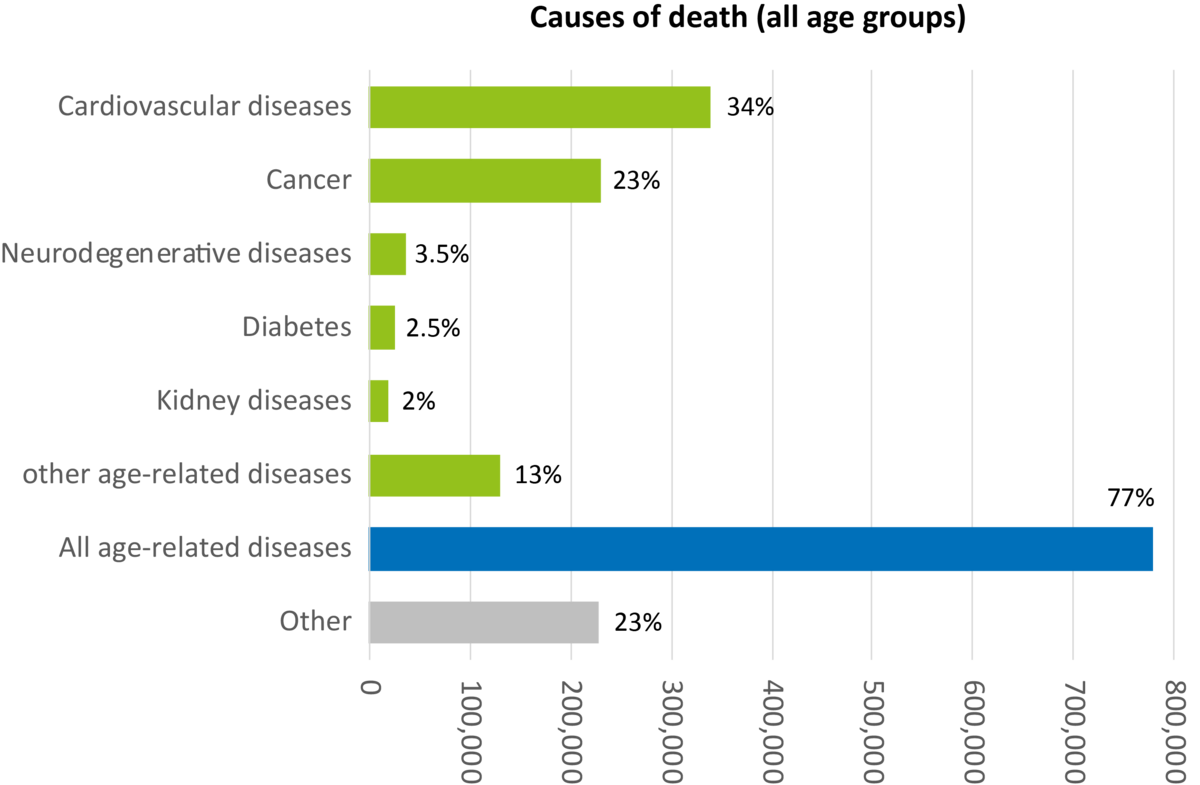
Some of the many age-related diseases we suffer from include:
- Cancer (leukaemia, lymphoma, melanoma, myeloma, mesothelioma…)
- Type 2 diabetes mellitus
- Osteoarthritis
- Osteoporosis
- Cardiovascular disease (ischaemic heart disease, stroke, heart failure, arrhythmia, myocarditis, atrial fibrillation, nonrheumatic calcific aortic valve disease, hypertension, atherosclerosis, intracerebral haemorrhage, subarachnoid haemorrhage…)
- Neurodegenerative diseases (Alzheimer’s disease, Parkinson’s disease, motor neuron disease…)
- Chronic obstructive pulmonary disease (COPD)
- Chronic kidney disease
- Gout
- Age-related macular degeneration
- Cataracts
- Glaucoma
- Sarcopenia
- Pancreatitis
- Peptic ulcer disease
- Paralytic ileus and intestinal obstruction
- Vascular intestinal disorders
- Asbestosis
- Interstitial lung disease and pulmonary sarcoidosis
We often suffer from several age-related diseases at once
Let's assume that we could completely cure cardiovascular disease, which kills more than one in three people. Shouldn't life expectancy increase significantly as a result? Surprisingly, this is not the case - we would only gain an additional 2 years. If we could cure cancer completely, we would gain another 3 years. Both diseases together account for more than half of all deaths and yet curing them would only give us 5 more years of life. Why is that?
The reason is that most people would die from another age-related disease within a relatively short time. From the age of 65, every second person suffers from two or more age-related diseases. Around half of all people over the age of 70 suffer from multimorbidity, i.e. they have at least three different chronic diseases at the same time. So, what really kills us in old age is ageing itself and the numerous age-related diseases it triggers.
However, a few people are spared these diseases and age healthily. One of the aims of our research is to understand how they do this.

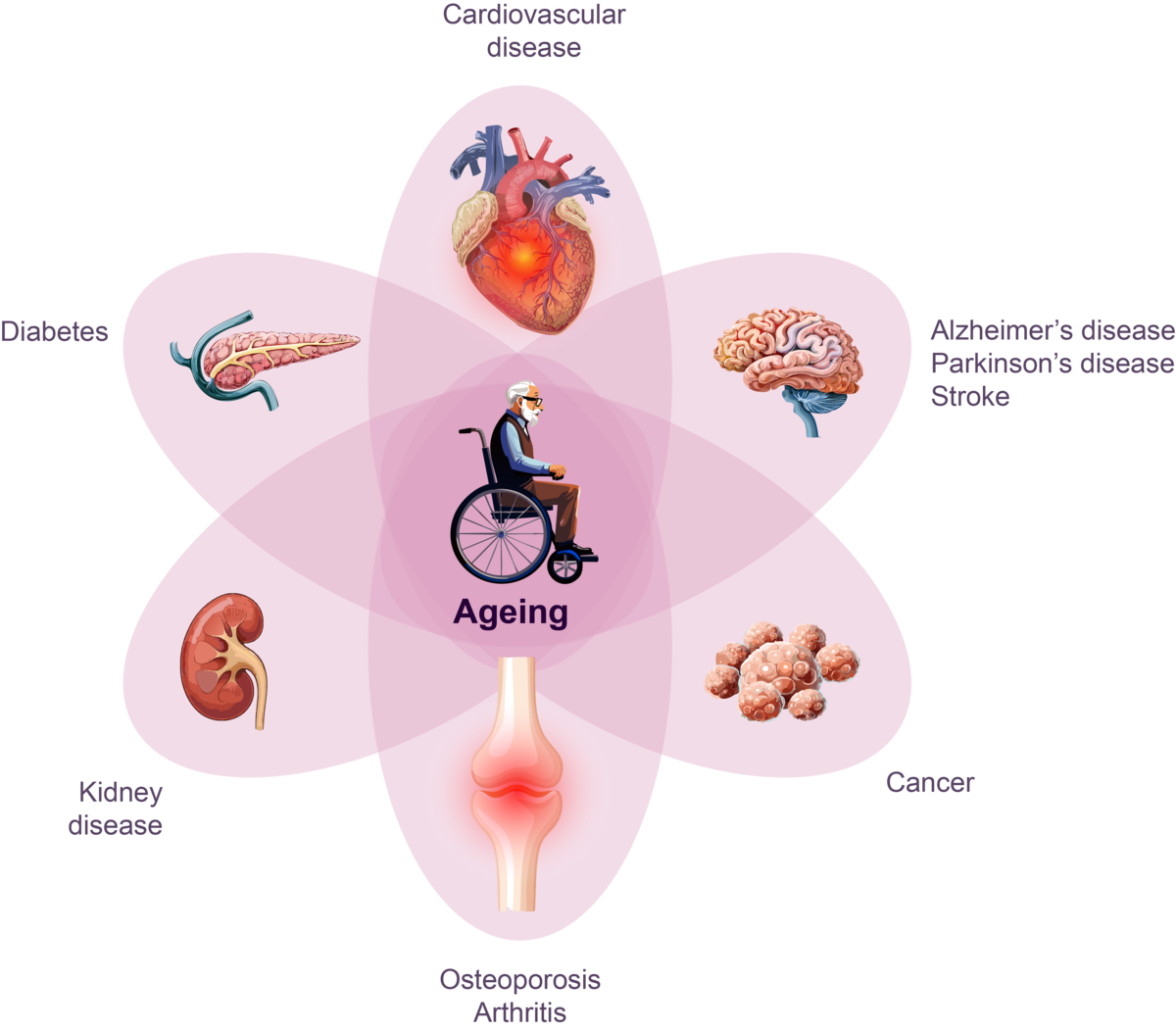
Until now, the healthcare system has generally treated age-related diseases individually, i.e. cardiologists treat heart disease, oncologists treat cancer and neurologists treat dementia. However, all these diseases are linked to one common denominator – ageing. If we could understand and manage the underlying biological mechanisms that cause ageing, we could prevent the subsequent development of multiple age-related diseases at once. That is, instead of treating age-related diseases as a consequence of ageing, we could target the root cause of multimorbidity by promoting healthy ageing.
The copyright for this text is held by the Centre for Healthy Ageing and Institute of Molecular Biology (IMB) gGmbH.
Authors: Vanessa Kellner (PhD), Cheryl Li (PhD), Samantha Schmaul (PhD) and Ralf Dahm (PhD).
This text is for general informational and educational purposes only. We make every effort to ensure that the information published is accurate and supported by the current scientific literature at the time of writing. This information is, however, not intended to provide medical advice or replace a qualified medical practitioner. Please consult your doctor or health care professional if you have any concerns or questions about your health or the information in this document.