
Curing age-related diseases and prolonging life?
We often suffer from several age-related diseases at once
Let's assume that we could completely cure cardiovascular diseases, which kill more than one in three people. Shouldn't life expectancy increase significantly as a result? Surprisingly, this is not the case - we would only gain an additional 2 years. If we could cure cancer completely, we would gain another 3 years. Both diseases together account for more than half of all deaths and yet curing them would only give us 5 more years of life. Why is that?
The reason is that most people would die of another age-related disease within a relatively short time. From the age of 65, every second person suffers from two or more age-related diseases. Around half of all people over the age of 70 suffer from multimorbidity, i.e. have at least three different chronic diseases at the same time. So, what really kills us in old age is ageing itself and the numerous age-related diseases it triggers.
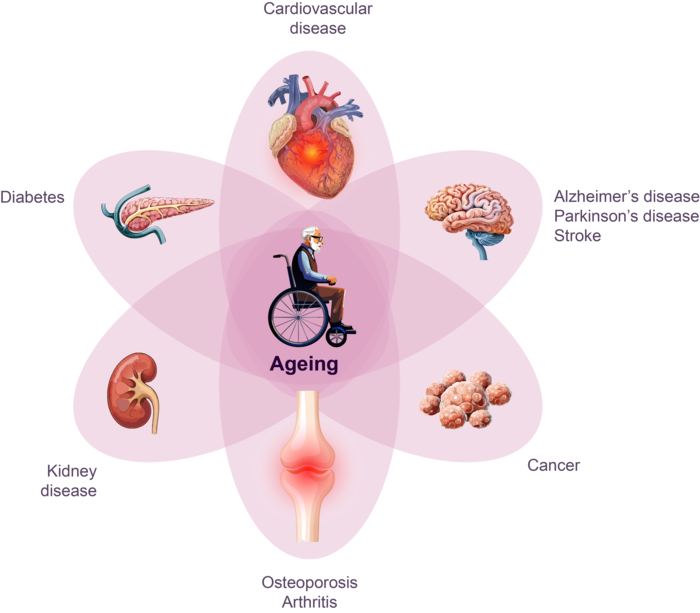
However, a few people are spared these diseases and age healthily. One of the aims of our research is to understand how they do this.
Until now, the healthcare system has always treated age-related diseases individually, i.e. cardiologists treat heart disease, oncologists treat cancer and neurologists treat dementia. However, all these diseases are linked to one common denominator – old age. If we could understand and manage the underlying biological mechanisms that cause ageing, we could prevent the subsequent development of all age-related diseases at once. That is, instead of treating age-related diseases as a consequence of ageing, we could prevent the root cause of multimorbidity by promoting healthy ageing.